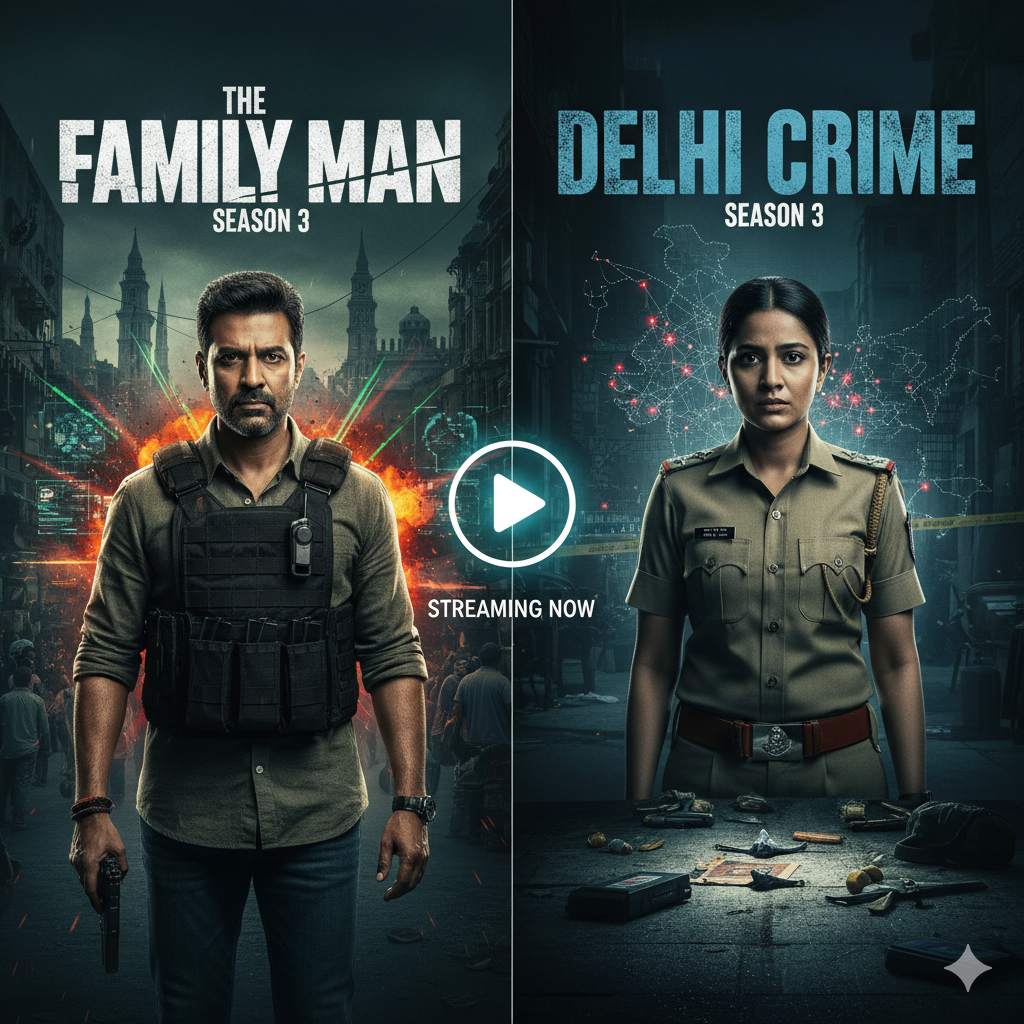
Indian streaming has entered a golden era. With every passing year, OTT platforms are setting new creative benchmarks, and few titles embody this evolution better than The Family Man and Delhi Crime. The return of both shows with their third seasons hasn’t just thrilled fans — it has reaffirmed India’s ability to produce global-quality stories rooted in local realities.
This deep-dive explores both series, their narrative strengths, performances, themes, and their wider impact on India’s streaming revolution.
India’s Streaming Rise: From Experimentation to Excellence
Not too long ago, Indian audiences were mostly limited to daily soaps and formula-driven dramas. Then came the OTT wave. Platforms like Prime Video, Netflix, Hotstar, and SonyLIV transformed audience expectations almost overnight.
Stories became sharper, bolder, and more honest.
The Family Man and Delhi Crime represent this shift — two shows that don’t just entertain but challenge, engage, and reflect India’s rapidly changing social fabric.
The Family Man: A New Breed of Spy Thriller
Raj & DK’s The Family Man broke the mold the moment it dropped. It reimagined the Indian spy hero through Srikant Tiwari — a man constantly torn between saving the nation and managing his chaotic household.
Manoj Bajpayee’s Srikant is not a high-octane action figure. He’s stressed, confused, and painfully relatable. That humanity is what makes the show a revelation.
Season 3: High Stakes, Human Heart
Season 3 expands the show’s scale by exploring geopolitical tensions involving India’s Northeast and neighboring countries. Instead of predictable spy antics, the narrative digs into cyber threats, covert missions, and ethical dilemmas.
Yet Srikant’s biggest struggle remains deeply personal: balancing national duty with family life.
One moment he’s stuck in an argument at home, and the next he’s in an intelligence briefing — this fluidity has become the show’s beating heart.
Performances that Elevate the Story
Manoj Bajpayee’s craft continues to astonish. His exhaustion, sarcasm, and vulnerability make Srikant one of the most compelling characters in Indian OTT history. Priyamani adds emotional complexity as Suchi, whose own internal conflicts play a crucial role in the narrative.
The ensemble cast — Sharib Hashmi’s lovable JK, Darshan Kumar, and newer additions — strengthen the story with depth and unpredictability. No one is painted as fully right or wrong. The nuance keeps the show grounded.
Craft and World-Building
Season 3 stays true to the show’s cinematic tone. The visuals are crisp yet real, capturing everything from cramped apartments to sprawling international settings.
What fans love most is the writing — the sharp humor, the bureaucratic satire, the moral ambiguity. The Family Man manages to be hilarious and tense without ever breaking its emotional rhythm.
How Audiences Responded
Season 3 sparked instant conversation online. Fans praised its balance of entertainment and socio-political insight. Many viewers see Srikant as the ultimate representation of modern Indian adulthood — overwhelmed, overworked, yet endlessly trying.
In an era where burnout is a shared reality, Srikant’s journey hits home.
Delhi Crime: The Conscience of Indian Streaming
While The Family Man entertains with tension and wit, Delhi Crime moves with emotional gravity. The first season — based on the aftermath of the 2012 Delhi gang rape — was a watershed moment. It won India its first Emmy and set the bar for grounded, socially conscious storytelling.
Season 2 deepened the show’s commitment to realism through an exploration of class, crime, and the moral burden carried by law enforcement.
Season 3 continues this legacy.
Season 3: Stories Born from Society’s Fault Lines
The third season examines crimes that emerge from systemic failure — neglect, inequality, and desperation. The writing never glamorizes violence or sensationalizes trauma. It treats crime as a window into deeper social fissures.
Every episode blends procedural detail with emotional honesty. The investigators aren’t portrayed as heroes or villains — they are human beings trying to work within the limits of a strained system.
Shefali Shah: A Masterclass in Controlled Power
Shefali Shah’s portrayal of DCP Vartika Chaturvedi is the soul of Delhi Crime. Her stillness, her quiet frustration, her empathy — all combine to create one of the most memorable characters on Indian television.
Rasika Dugal and Rajesh Tailang deliver equally nuanced performances, enriching the series with moral complexity.
Shah proves that power on screen doesn’t always come from loud moments; sometimes it comes from the silence between them.
Visual Storytelling and Direction
Delhi itself becomes a character in Season 3 — sprawling, chaotic, and endlessly contradictory. The muted tones, handheld shots, and meticulous pacing reflect the emotional fatigue of the city’s residents and police force alike.
The direction remains uncompromising. It respects the audience’s intelligence and doesn’t shy away from uncomfortable truths.
A Legacy of Impact
Delhi Crime remains India’s most internationally acclaimed series. Beyond awards, it has earned a reputation for honesty, restraint, and empathy. It refuses to turn crime into spectacle — instead, it asks the audience to reflect.
In many ways, Delhi Crime is not a “cop show” but a social meditation.
How These Shows Reflect India’s Streaming Growth
The success of The Family Man and Delhi Crime reflects wider trends across Indian OTT platforms:
- Regional textures are gaining prominence. Shows now blend languages, cultures, and accents with authenticity.
- Bigger budgets allow for more ambitious storytelling.
- Data insights help platforms invest in long-term creative partnerships.
- Taboo themes are being handled with nuance rather than sensationalism.
- Global recognition is pushing creators to elevate narrative and technical quality.
Indian OTT is no longer derivative — it is defining its own identity.
Two Shows, Two Worlds — One Cultural Moment
Here’s how they compare:
| Aspect | The Family Man | Delhi Crime |
|---|---|---|
| Genre | Spy-thriller, dark comedy | Crime drama, social realism |
| Tone | Fast, witty, satirical | Serious, introspective |
| Lead | Manoj Bajpayee | Shefali Shah |
| Themes | Duty vs family, geopolitics | Justice, social decay, gender |
| Appeal | Broad audience | Global critics + mature viewers |
They may be stylistically different, but both series reflect contemporary India — its contradictions, challenges, humor, and humanity.
India on the Global Stage
What makes these shows truly significant is how they resonate worldwide. They don’t mimic Western narratives; they reinterpret them through an Indian lens.
Global audiences connect to their emotional truths — to Srikant’s exhaustion, to Vartika’s moral dilemmas, to the universality of fear, hope, and resilience.
They have helped shift international perceptions of Indian storytelling from “colorful and musical” to “complex, layered, world-class.”
Looking Ahead: What These Shows Mean for the Future
As Season 3 of both series makes waves, they remind viewers what streaming can be — not just entertainment, but reflection.
- The Family Man speaks to our era of surveillance, digital anxiety, and political polarization.
- Delhi Crime explores the heavy cost of systemic breakdown and societal neglect.
Together, they show how Indian creators are embracing stories that are both intimate and universal.
Conclusion: More Than Just Shows
The success of these two series proves that great storytelling still commands attention. Whether through laughter or introspection, both The Family Man and Delhi Crime demonstrate that audiences want depth, nuance, and honesty.
Indian streaming is no longer in its experimental phase — it has arrived. And with shows like these leading the charge, its global influence is only just beginning on Netflix