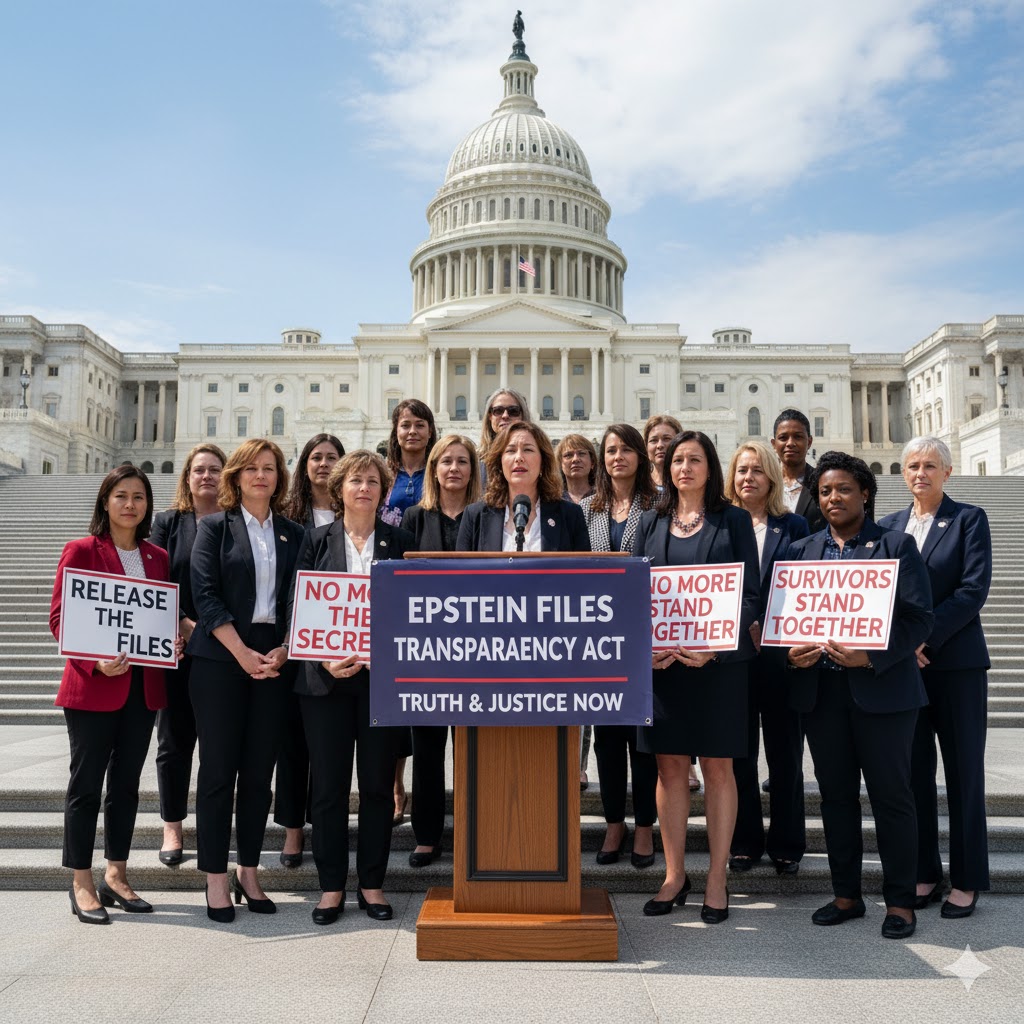
Washington, D.C. witnessed an extraordinary moment recently—one that transcended politics, partisanship, and the swirl of controversy surrounding the late financier and convicted sex offender Jeffrey Epstein. A group of women, survivors of Epstein’s abuse, traveled to the nation’s capital not to revisit pain for its own sake, but to demand truth, transparency, and accountability from a system that failed them for years.
Their powerful public testimonies coincided with the advancement of the Epstein Files Transparency Act, a bipartisan bill that would compel the U.S. Department of Justice to release tens of thousands of pages of unclassified government files related to the case.
But beyond legislative victories, the day belonged to the survivors—women who stood before cameras, lawmakers, and the world, holding photos of themselves as teenagers. Photos taken before Epstein entered their lives. Before their innocence was stolen.
Their message was clear:
Release the files. Tell the truth. Let justice finally begin.
The Survivor Testimonies: Courage Beyond Words
Personal Stories of Survival
The press conference at the Capitol was raw, emotional, and unlike anything seen in the Epstein saga so far. Survivors including Ouska Georgiou, Haley Robson, Marina Lacerda, and Chauntae Davies spoke in deeply personal terms about the years of grooming, coercion, and sexual abuse they endured.
Many were abused as teenagers — vulnerable, isolated, and chosen intentionally by Epstein’s network of recruiters.
- Ouska Georgiou described the psychological conditioning she experienced as a young teenager, recalling how she was manipulated into believing Epstein’s behavior was normal, even caring.
- Haley Robson, once labeled by prosecutors as one of Epstein’s “recruiters,” spoke of her own victimization and how she was drawn into a system she was too young to understand.
- Marina Lacerda broke down while discussing the lifelong trauma—flashbacks, anxiety, and the weight of shame she carried for years.
- Chauntae Davies, a former flight attendant on Epstein’s private jet, recounted incidents of assault on the plane later infamously nicknamed “The Lolita Express.”
Each woman held a photo of herself at the age she was preyed upon — a haunting visual reminding the world that these were children, not willing participants.
“We were kids. Babies. We did nothing wrong,” one survivor said, her voice trembling.
They called on political leaders — including the president — to place humanity above politics and commit to full transparency.
Impact of Survivor Voices
These testimonies have done what investigations, documentaries, and media exposés could not fully achieve:
They put a human face on the systemic failures surrounding Epstein’s operation.
Their courage has shifted public discourse, accelerated legislative action, and sparked a broader survivor-led movement pushing for an end to institutions that enable sexual abuse by powerful individuals.
The Epstein Files Transparency Act: A Legislative Milestone
The Bill’s Purpose and Provisions
The Epstein Files Transparency Act aims to force the Justice Department to release all unclassified government files related to Epstein, spanning:
- FBI records
- DOJ correspondence
- Federal investigations
- Names of individuals whose actions may have allowed Epstein’s crimes to continue
Early estimates suggest between 33,000 and 100,000 pages of documents exist — a staggering volume that could reveal critical information about how Epstein operated, who may have enabled him, and what authorities overlooked.
Victim names and identifying details would be protected.
The Unusual Legislative Journey
What makes this bill exceptional is not just its content — but the political path it took.
The bill has rare bipartisan support, with lawmakers as ideologically distant as:
- Ro Khanna (D)
- Thomas Massie (R)
- Marjorie Taylor Greene (R)
- Lauren Boebert (R)
Lawmakers overcame resistance from leadership through a rare mechanism known as a discharge petition, effectively bypassing traditional committee roadblocks. This parliamentary maneuver is so uncommon that it signaled how strongly lawmakers felt about the issue.
The Senate passed the bill unanimously.
The House is expected to follow.
And the president has indicated he will sign it.
Political Tension and Survivor Responses
Despite the bipartisan push, the bill has not been free from controversy.
Some political figures, including former President Trump, initially expressed skepticism. Parts of the political right pushed the narrative that the bill was designed to target Trump himself — a claim survivors rejected emphatically.
As one survivor said:
“This is not about Republicans or Democrats. This is about children who were abused and a system that protected powerful men.”
White House warnings that support for the bill could be construed as politically hostile only heightened the tension — but survivors insisted the bill must rise above politics.
Broader Implications: Truth, Transparency, and Justice
Accountability Beyond Epstein
Epstein is dead.
But his network is not.
For years, survivors have insisted that Epstein did not operate alone — that enablers, accomplices, recruiters, financiers, and public officials helped protect him.
The release of government files may expose:
- Individuals who participated
- Officials who ignored warnings
- Institutions that turned a blind eye
- Failures across law enforcement agencies
Survivors have also been compiling names privately, building dossiers to ensure no evidence is lost.
Support and Healing for Survivors
Beyond transparency, survivors are asking for:
- Long-term trauma counseling
- Legal services
- Financial assistance
- Protections against retaliation
- Education about grooming and coercion
The Epstein case illustrates how deep and lifelong the wounds of childhood abuse can be — and how urgently society must respond.
A Cultural and Institutional Reckoning
The Epstein scandal has already shaken public faith in:
- Law enforcement
- Prosecutors
- Intelligence agencies
- Political elites
- The justice system
But releasing these files could finally spark the institutional reckoning survivors have sought for years.
This moment is about more than Epstein.
It’s about dismantling systems that allow powerful predators to operate with impunity.
Conclusion: A New Chapter for Survivors and Justice
The survivors who stood in Washington brought something rare into a city consumed by politics: truth, vulnerability, and unfiltered courage.
Their voices — once silenced — are now shaping federal law.
Their stories — once hidden — are now driving a national movement for transparency.
And their demands — justice, accountability, and truth — might finally be met if the Epstein Files Transparency Act becomes law.
Releasing the files will not erase their trauma.
But it will expose the full scope of the network that allowed Epstein to operate.
It will bring long-overdue accountability.
And it will send a message to future survivors:
You deserve truth. You deserve protection. And your voice can change history.